
ASD, Speech and Vitamin B12
-
Lack of speech is very common in autism
-
Generally the cause is functional B2 deficiency
-
Functional B2 deficiency is often due to lack of Iodine and/or Selenium in the child
-
The dopamine breakdown product HVA is over-produced in autism
-
Over-production of dopamine is one of the defining symptoms of vitamin B12 deficiency
-
Treatment involves identification of the cause of vitamin B2 deficiency
-
Treatment involves the use of the RnB protocol
ASD, language and Vitamin B2 deficiency
Approximately 25% to 30% of children diagnosed with autism either do not develop functional language or are minimally verbal, meaning they have limited speech capabilities.
Nonverbal Autism: Research indicates that about 25% to 30% of autistic individuals are considered nonverbal, meaning they do not develop functional spoken language
Functional Speech: Approximately 30% of individuals with autism do not develop speech that is sufficient for meeting everyday communication demands
Minimally Verbal: Estimates suggest that around 25% to 30% of children with autism are minimally verbal, using fewer than 30 functional words or relying on alternative communication methods
Language can be subdivided into Receptive and Expressive Language. Receptive language refers to the ability to understand what is said, and to process it, whilst Expressive language involves the ability to communicate thoughts and feelings through spoken or written words. Clearly the ability of a child to understand a question and then to answer the question involves the combination of the two processes.
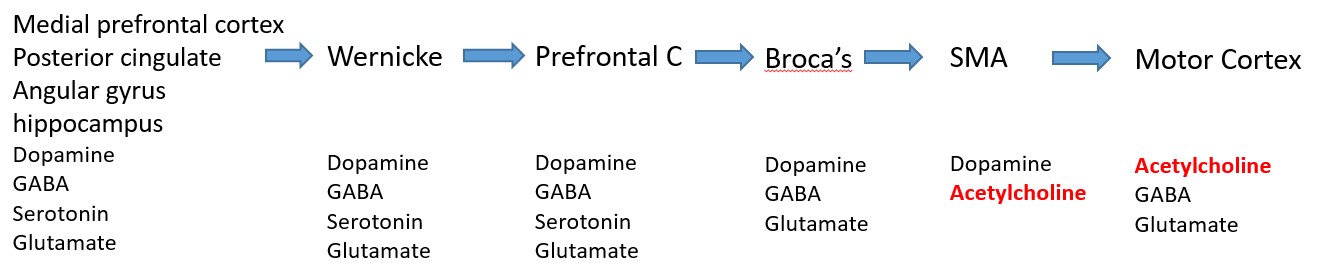
Generation of thought, prior to expression of the thought requires the generation and collaboration of many neurotransmitters. See below for the transmitters in original thought
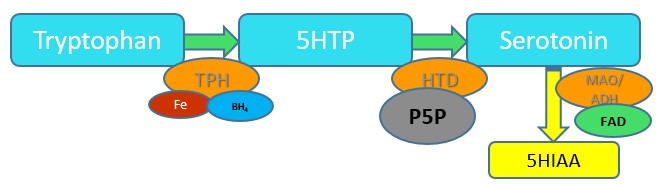
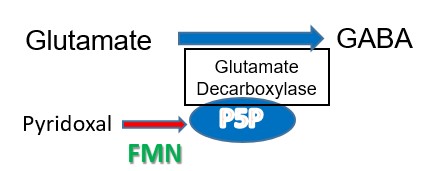
Successful production of the neurotransmitters serotonin and GABA are dependent upon the active form of vitamin B6, PLP, which in turn is dependent upon FMN, one of the active forms of vitamin B2. Activation of riboflavin, in turn requires Iodine and Selenium. see Serotonin, below and GABA.
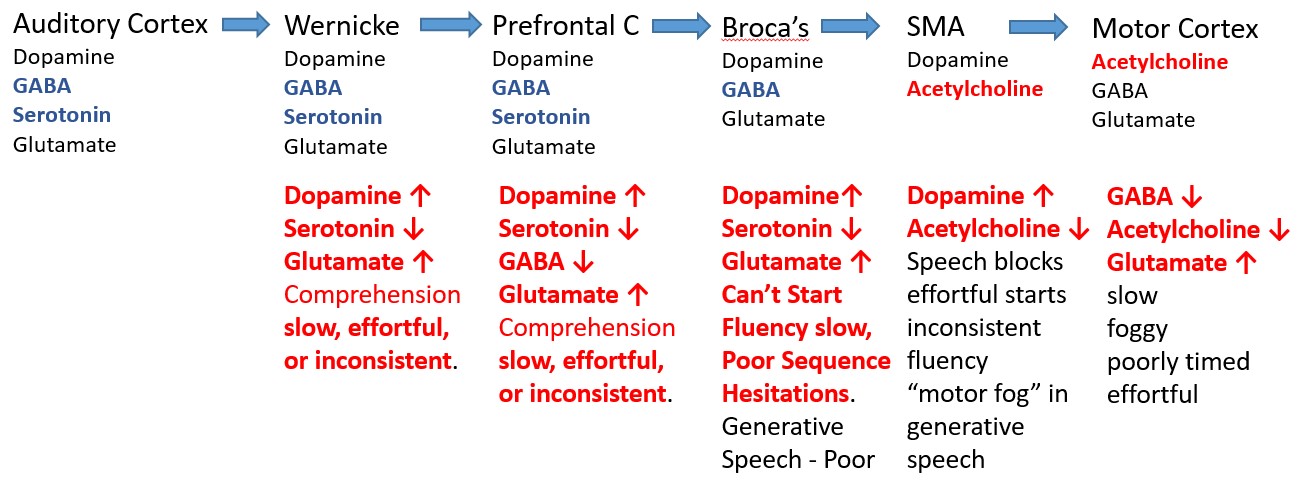
Studies by Russell-Jones, have shown that the majority of persons with ASD have deficiencies in Iodine, and/or Selenium, and as such would be deficient in functional B2, and would therefore be deficient in functional B6. This then significantly affects the generation of speech. As can be seen in the cartoon, nearly every step in the production of expressive language would be affected. Little wonder that so many people with ASD would have troubles with speech.
Treatment of Deficiencies associated with lack of Speech ASD
The resolution of vitamin B12 deficiency involves identification of the cause of vitamin B2 deficiency. Then resolving the B2 deficiency as per the RnB protocol. Critical in the resolution appears to also be fixing acetylcholine deficiency, a deficiency that is known to be common in children with autism, and in adults with Alzheimer's disease.
Resolution of the B2 deficiency involves daily application of Iodide, Selenite, and Molybdate oils (see https://b12oils.com/products.htm), as per the RnBTM protocol, plus oral administration of vitamin B2, and topical Adenosyl/Methyl B12 oils. In addition, some increased rate of success has occurred with daily administration of alphaGPC, to try to resolve the inevitable Acetylcholine deficiency.
Synthesis of Phospatidylcholine (PC) from phosphatidylethanolamine (PEA) by the enzyme phosphatidylethanolamine N-methyltransferase. Phosphatidylcholine is a precursor to the synthesis of choline, for production of acetylcholine (Vance et al, 1997)- Reduced Acetylcholine production is common in Alzheimer's disease and autism (Ferri etal, 2005; Stanciu etal, 2019; Grossberg, 2017; Perry 1988; Dumas and Newhouse, 2011; Bartus etal, 1982). Conversion of PC to PEA has been proposed as being one of the biggest users of SAM in the body (Ducker and Rabonowitz, 2017).
Rote learning and Speech in ASD
Speech training should concentrate on repetition and Rote learning. In rote learning, information is leant through repetition. Information is stored in blocks, rather than being learnt by association. This enables faster recall with less energy usage. Some links to rote learnign and expressive language are outlined at the end of this section.
References
Perry E. (1988). Acetylcholine and Alzheimer's disease.
The British journal of psychiatry : the journal of mental science, 152, 737–740. https://doi.org/10.1192/bjp.152.6.737Dumas, J. A., & Newhouse, P. A. (2011). The cholinergic hypothesis of cognitive aging revisited again: cholinergic functional compensation.
Pharmacology, biochemistry, and behavior, 99(2), 254–261. https://doi.org/10.1016/j.pbb.2011.02.022Vance, D. E., Walkey, C. J., & Cui, Z. (1997). Phosphatidylethanolamine N-methyltransferase from liver. Biochimica et biophysica acta, 1348(1-2), 142–150. https://doi.org/10.1016/s0005-2760(97)00108-2<
Stanciu, G. D., Luca, A., Rusu, R. N., Bild, V., Beschea Chiriac, S. I., Solcan, C., Bild, W., & Ababei, D. C. (2019). Alzheimer's Disease Pharmacotherapy in Relation to Cholinergic System Involvement. Biomolecules, 10(1), 40. https://doi.org/10.3390/biom10010040
Grossberg S. (2017). Acetylcholine Neuromodulation in Normal and Abnormal Learning and Memory: Vigilance Control in Waking, Sleep, Autism, Amnesia and Alzheimer's Disease. Frontiers in neural circuits, 11, 82. https://doi.org/10.3389/fncir.2017.00082
Vance, D. E., Walkey, C. J., & Cui, Z. (1997). Phosphatidylethanolamine N-methyltransferase from liver. Biochimica et biophysica acta, 1348(1-2), 142–150. https://doi.org/10.1016/s0005-2760(97)00108-2<
Bartus, R. T., Dean, R. L., 3rd, Beer, B., & Lippa, A. S. (1982). The cholinergic hypothesis of geriatric memory dysfunction. Science (New York, N.Y.), 217(4558), 408–414. https://doi.org/10.1126/science.7046051
What Is Rote Learning? Definition, Examples and Uses
Expressive vs. Receptive Language | TherapyWorks
Copyright © 2018 B12 Oils. All Rights Reserved.
Reproduction in whole or in part in any form or medium without express written
permission is prohibited