
Vitamin B12 MTHFR Folate cycling
Methylation, vitamin B12,
the Folate Cycle and Mutations in
Relevant Genes
There are over 100 methylation
reactions within the cell,
the majority of which
require
S-adenosylmethionine
(SAM), the production of
which is
intimately associated
with the uptake of
dietary methionine, the
folate cycle and
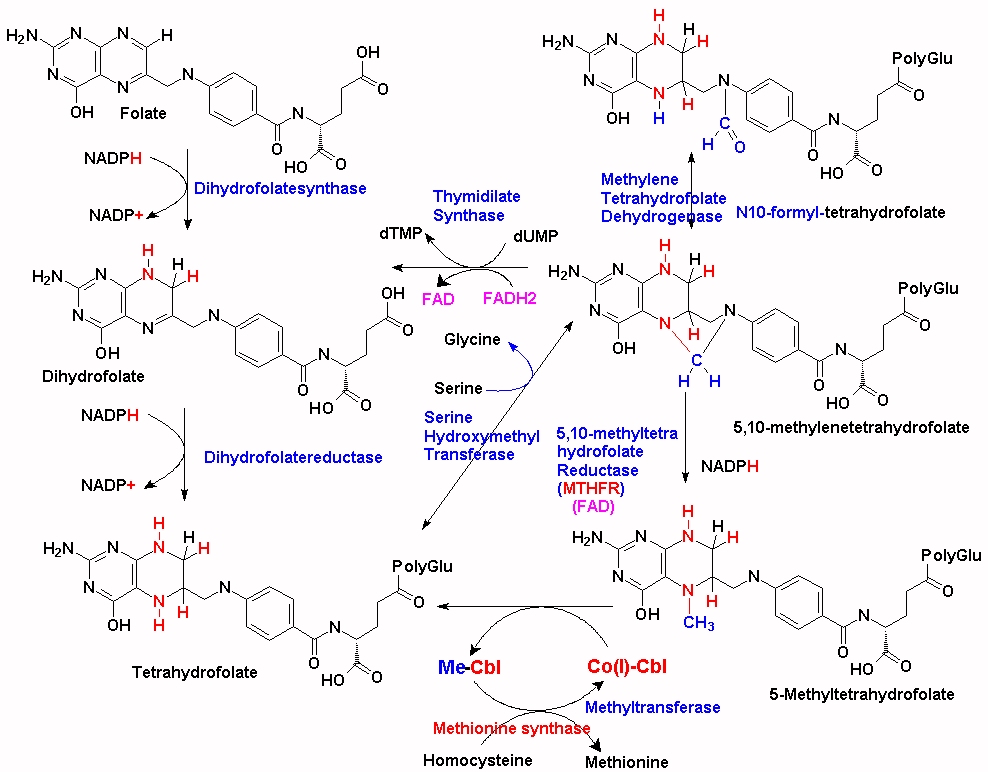
methylcobalamin. Normal cycling of folate
results in the formation
of an irreversible
reaction in which 5, 10 methylenetetrahydrofolate
is converted to
5-methyltetrahydrydrofolate
(5-MTHF) by the enzyme
5,10
methyltetrahydrofolate
reductase (MTHFR). Of
note in this reaction is
that MTHFR uses FAD
(derived from
riboflavin, vitamin
B2) as an essential
cofactor.
Without this cofactor
the enzyme, MTHFR will
not function.
In addition,
the reduction that
occurs requires input
from NADH + H+
(derived from
nicotinamide,
vitamin B3). In the
absence of these two
vitamins (B2/B3) the
enzyme is not
functional. The
activity of the enzyme
can be affected by
various mutations in the
protein. Mutations that
affect function
generally involve the
binding of FAD to the
protein, and are very
sensitive to FAD
concentration.
In
the absence of vitamin
B12 (Co(I)-Cbl),
dietary 5-MTHF cannot
enter the folate cycle
and is not
polyglutaminated, and
cannot accumulate inside the
cell, with the result
that the levels of
available intracellular folate are
reduced> In the absence
of methylcobalamin, the
levels of homocysteine,
an end product of the
methylation cycle,
are gradually raised, eventually
leaving the cell and
increases in serum.
Elevated homocysteine is
associated with an increased risk
in
cardiovascular disease,
as well as regional
brain atrophy..
The majority of the
methyl groups that are
used to make 5MTHF in
the cell come from
serine, via the enzyme
serine
hydroxymethyltransferase
(SHMT)(See
JPG). This is then
transferred via MTHFR to
the methylation cycle as
5MTHF.
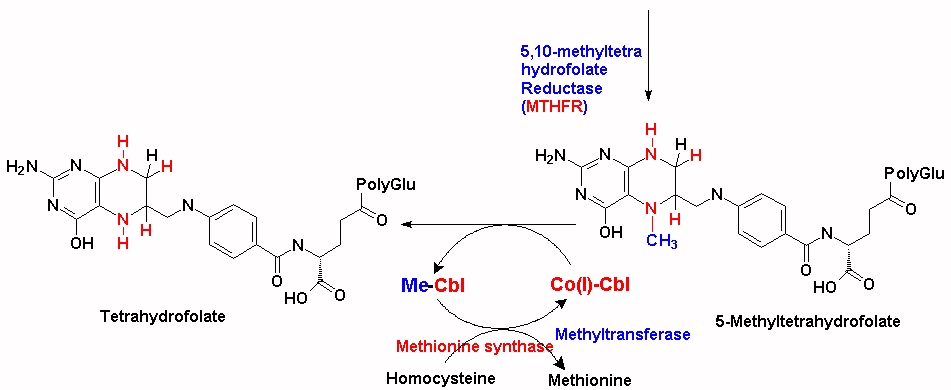
In order for the methyl
group "acquired" during
the folate cycling to
enter the methylation
cycle,
vitamin
B12 (Co(I)-Cbl)
associated with
methionine synthase
accepts the methyl group
from 5MTHF
which then
forms both methyl-cobalamin (MeCo(III)Cbl)
and tetrahydrofolate (THF).
THF can
then enter the
folate cycle.
Methionine synthase then
transfers the methyl group
from MeCbl to homocysteine,
which
is converted to methionine,
and Co(I)Cbl is reformed.
Mutations in the MTHFR
gene.
There many
different mutations in
the MTHFR gene, and
nearly everyone has one
or more, variants of the
gene, which may or may
not affect the function
of the MTHFR enzyme.
Unfortunately the
frequency of such
variants is not widely
understood in the
general population, so
much so that a certain
amount of web-hysteria
has result. As an
example, one of the
common genetic allels is
known as the MTHFRC665T
allele (rs1801133).
Roughly half the
population (or around
3.5 billion people) are
heterozygous, CT, for
this allele, with 12-20%
(depending upon
ethnicity) homozygous TT
and 30-38% homozygous
CC.
In persons with
some
mutations in the MTHFR
gene, the enzyme has
slightly
reduced activity and so
the speed at
which
5MTHF
is produced from
the folate cycle is
reduced,
and so the 5MTHF + Co(I)Cbl
<=> THF + MeCbl reaction
operates
slightly less
efficiently. As a result
new/incoming
supplies of MeCbl must
be used for processing
homocysteine, leading to
a more rapid reduction
in vitamin B12.
This reduction is most
rapid in conditions of
low functional vitamin
B2 (FAD).
(The
extent of reduction is
dependent upon how many
and which types of
mutations occur in the MTHFR and other
methylation associated genes).
Every
methyl group used in
synthesis must be
supplied by
MeCbl.
,
either acquired
by supplementation or
from 5MTHF. In the
absence of sufficient
5MTHF, there is
rapid depletion of
VB12 stores. An
alternative solution is
to supply dietary
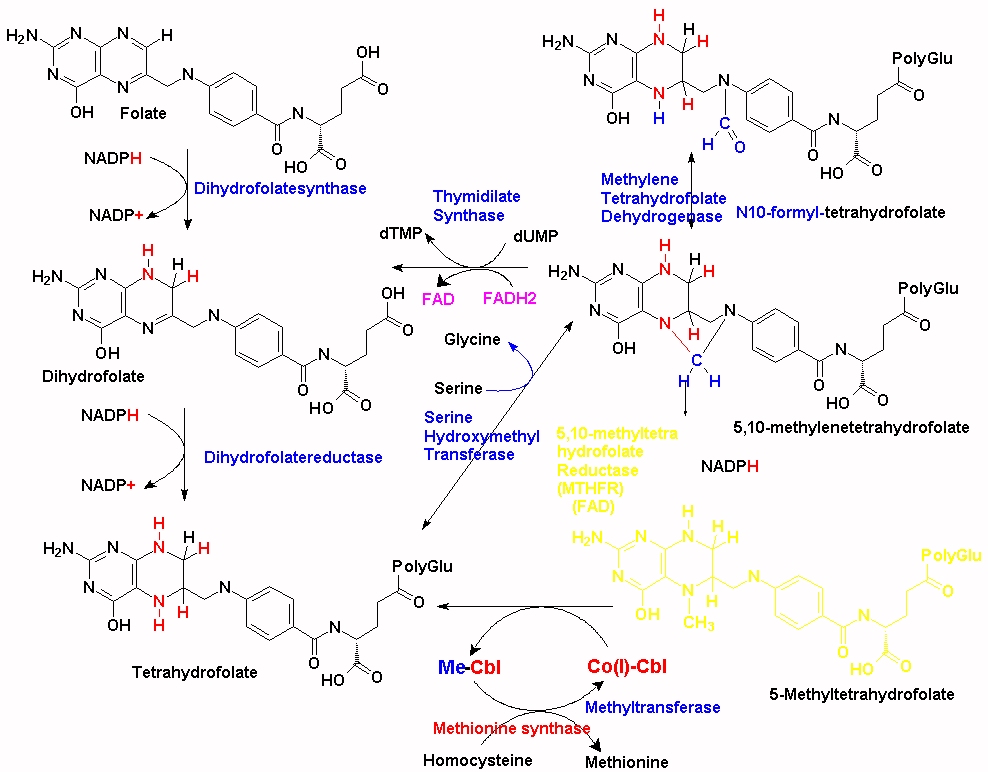
folate as
5MTHF (See
Fig2), or increase
the amount of folate
that is cycling via a
folic acid supplement
(See
Fig3)
and
Co(I)+Cbl, but
as this also is not
recycled a new molecule
of 5MTHF must always be
supplied or the newly
synthesized
Co(I)-Cbl
also will run
out. Thus in these
individuals they need a
constant supply of both
MeCbl AND 5MTHF.
An alternative solution
is to increase the
amount of vitamin B2,
which will increase the
activity of MTHFR.
Other
genetic mutations which
affect these reactions
are mutations in the
genes for methionine
synthase, methionine
synthase reductase, SHMT
and cystathione
synthase.
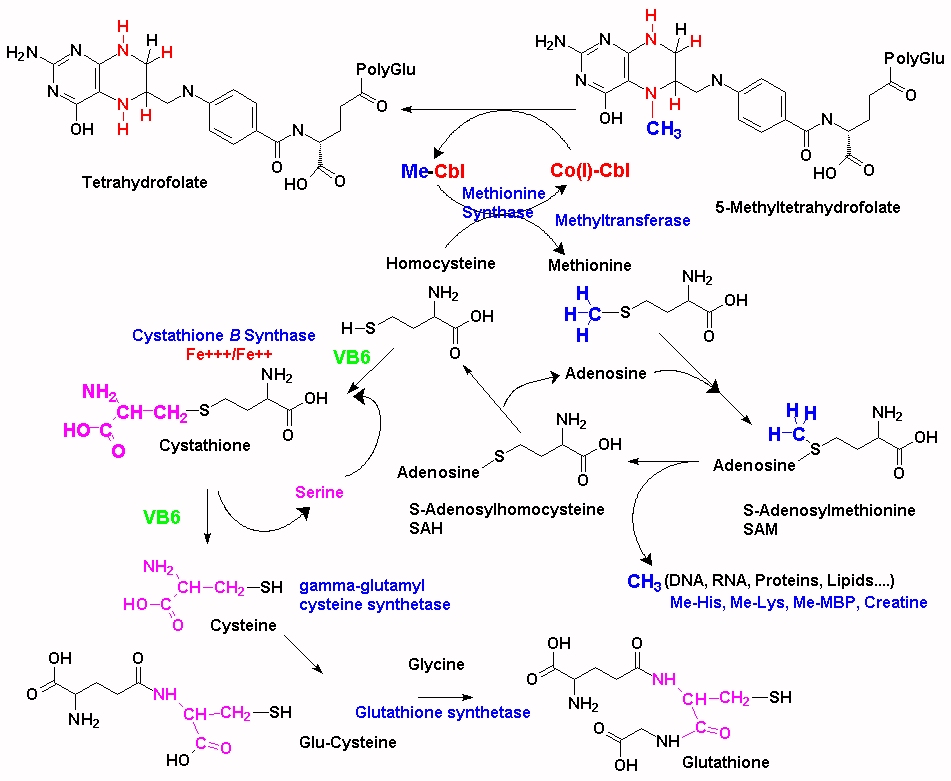
Production of SAM, its
relationship to folate
and the build up of
homocysteine
In normal individuals,
MeCbl
reacts with
homocysteine, to
form methionine and
Co(I)Cbl is
formed. If sufficient folate
is present, 5-methyltetrahydrofolate
is produced as an
alternative product of the folate
cycle. In the presence
of
Co(I)Cbl this
methyl group is
transferred from 5MTHF
to
Co(I)Cbl to form
MeCbl
and THF is regenerated.
In vitamin B12 deficient
individuals,
homocysteine
accumulates within the
cell and cannot be used
to convert
5MTHF to THF. This in itself
can lead to functional folate
deficiency within the
cell. Thus, although serum
levels may be normal or
elevated.
Co(I)Cbl is
absent and so the methyl
group from dietary 5MTHF
cannot be transferred
to
MeCbl
and thence to
homocysteine =>
methionine and hence a
deficiency in SAM
results. DNA, RNA and
proteins are not
methylated and this can
lead to defective
function and cancer.
Even in people who start
being vitamin B12
sufficient, the constant
demand for methylation,
and the lack of 5MTHF,
leads to the usage of
MeCbl
and ultimately leads to
vitamin B12
deficiency.
Dietary folate is
predominantly 5-MTHF, and
this must first be processed
by methionine synthase
+*CoVB12 in order for the
folate to enter the folate
cycle as THF. In vitamin B12
deficiency this cannot
happen and so the folate and
the methyl group are
"trapped" as 5MTHF and
virtually ineffective.
Addition of folate (folic
acid) as a supplement
partially alleviates this as
the folate cycle can
proceed. One problem with
this approach is that
methionine is used in
protein synthesis and so
intracellular methionine
stores become depleted. The
resultant lack of SAM "turns
on" MTHFR, which then pumps
the
5,10-methylenetetrahydroflate
into 5MTHF synthesis, which,
in the absence of VB12 is
once again "trapped",
thereby consuming the added
folate. Addition of folate
to MTHFR +/+ individuals
reduces the "trapping" of
folate, however, residual
methionine is lost by
further usage in protein
synthesis, thus further
reducing the intracellular
levels of SAM.
Supplementation with excess
methionine or SAM can boost
methylation however it also
leads to the increased
production of homocysteine,
with its own toxicity. It is
apparent, therefore, that
proper nutritional
supplementation would
require 5MTHF, plus methyl
B12 and possibly methionine
(depending upon the
nutritional status of the
individuals.
Compounding
this problem is the need for
intracellular folate to be
modified with polyglutamate.
Without this polyglutamation
the folate rapidly diffuses
out of the cell. In a
curious quirk of fate,
5-MTHF is not a particularly
good substrate for the
enzyme folylpolyglutamate
synthetase, so unless 5MTHF
is administered with vitamin
B12 and hence allowed to
rapidly enter the folate
cycle, thereby being polyglutamated, it is
rapidly lost from the cell.
(see McGuire etal, 1979
http://www.jbc.org/content/255/12/5776.full.pdf
)
The
methyl/folate trap and how
it relates to MTHFR
Role of
methylation mutations such
as MTHFR in the development
of
other
conditions


MTHFR mutations have also been correlated with a higher incidence of various conditions including heart disease, stroke, high blood pressure (hypertension), high blood pressure during pregnancy (preeclampsia), glaucoma, psychiatric disorders (schizophrenia, depression, bipolar disease), and certain types of cancer. The correlation though is somewhat small as too is the increased incidence (generally less than two-fold).
More recently studies have shown a significant correlation between MTHFR TT mutations, reduced vitamin B12 and Parkinson's Disease. A positive correlation has also been shown between MTHFR mutations and rheumatoid arthritis
More recently it has been shown the many people with Chronic Fatigue Syndrome (CFS/ME) have methylation mutations
Other important methylation reactions
Apart from the formation of methylated myelin basic protein, the are over 200 methylation reactions in the body including the production of creatine (involved in energy production), CoQ10 (an essential electron shuffle vector in the electron transport chain), carnitine (involved in uptake of fatty acids into mitochondria), the production of phosphatidyl-choline, adrenalin, melatonin (essential for neuronal development, gut health, and sleep),myelin basic protein, methylation of lysine, histidine and arginine, and in the inactivation of histamine, dopamine, nor-adrenalin, and adrenalin, amongst others.
Role of MTHFR and Multiple Sclerosis
Essential in the formation of myelin sheath is its association with myelin basic protein (MBP). In order for MBP to associate with the myelin it must first be post-transationally modified by methylation of arginine. If the arginine is not methylated, the structure of MBP is changed and otherwise buried arginine residues are exposed. These can then act as substrates for nitric oxide synthase (NOS), which converts arginine to citrulline. This then is a different MBP from normal and hence can generate an immune response to MBP and MS may develop. MTHFR mutations have been correlated with MS, as too has VB12 deficiency.
MTHFR and Pregnancy
Many people with methylation mutations such as MTHFR have trouble getting pregnant or maintaining their pregnancy. The baby born to an MTHFR positive mother and/or father can inherit the condition. A lack of folate/and or vitamin B12 particularly in these individuals can lead to Spina bifida, anenceaphaly, and Down's syndrome. Elevated homocysteine can lead to low birth weight and premature babies. Previous studies suggested that more than 80% of babies with autism have some kind of methylation mutation. More recent studies performed by out group have contradicted this. Our studies have rather shown that every child with autism has a combination of functional vitamin B2 deficiency and paradoxical B12 deficiency. This functional B2 deficiency leads to reduced activity of the MTHFR enzyme, particularly in those with mutations in the gene, and as such regeneration of 5MTHF from within the folate cycle is reduced, leading to lower levels of methylation in these individuals.
Copyright © 2018 B12 Oils. All Rights Reserved.
Reproduction in whole or in part in any form or medium without express written
permission is prohibited